Voyager by Diana Gabaldon (book review)

July 8th, 2011 by monnibo

Voyager by Diana Gabaldon (Outlander Series #3)The good news is that I didn’t cry as much reading Voyager (book three in the Outlander Series) as when I read Dragonfly in Amber. But I still fell hard for the story and the characters. Diana Gabaldon just has a way with words that draws the reader in completely and holds you there.

Warning: Minor spoilers of earlier books are contained in the book description. If you are interested in the series but don’t want to ruin anything, start by reading my review of Outlander, the first book in the series.

Their passionate encounter happened long ago by whatever measurement Claire Randall took. Two decades before, she had traveled back in time and into the arms of a gallant eighteenth-century Scot named Jamie Fraser. Then she returned to her own century to bear his child, believing him dead in the tragic battle of Culloden. Yet his memory has never lessened its hold on her… and her body still cries out for him in her dreams.

Then Claire discovers that Jamie survived. Torn between returning to him and staying with their daughter in her own era, Claire must choose her destiny. And as time and space come full circle, she must find the courage to face the passion and pain awaiting her…the deadly intrigues raging in a divided Scotland… and the daring voyage into the dark unknown that can reunite—or forever doom—her timeless love.

From the publisher, Seal Books (an imprint of Random House)

My only complaint with that synopsis is the last line of the first paragraph:and her body still cries out for him in her dreams.” It just sounds so cheezy and bad-Harlequin-romance. It annoys me because while, yes, this series does have sex scenes and a romantic plot line, it is so much more than that. Okay, done rant.

Second Warning: I will now talk about the book’s events … look away now if you don’t want spoilers. Otherwise, continue at your own risk!

Read the rest of this entry »

Bookmark and Share

Category: Books, Reviews | 1 Comment »

Dragonfly in Amber by Diana Gabaldon (book review)

June 17th, 2011 by monnibo

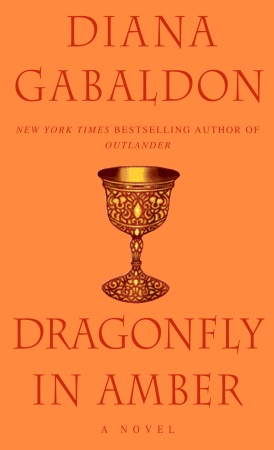
Dragonfly in Amber by Diana GabaldonNearly immediately after finishing Outlander, the first book in the Outlander series by Diana Gabaldon, I picked up book two, Dragonfly in Amber. [Click here for my review of Outlander]

The first book had immediately drawn me in to Claire and Jamie’s story with adventure, romance, history, and a little bit of science fiction. It ended on a cliffhanger (as all good series tend to) and I picked up the next book in eager anticipation.

I was immediately distressed — Dragonfly in Amber begins twenty years after the end of Outlander. I will admit that I went to read the back of book three (Voyager) to ease my mind and heart. Fortunately, the beginning chapters are set in 1968 to frame the story for new  readers and then proceeds to tell what happened since the end of Outlander.

For twenty years Claire Randall has kept her secrets. But now she is returning with her grown daughter to Scotland’s majestic mist-shrouded hills. Here Claire plans to reveal a truth as stunning as the events that gave it birth: about the mystery of an ancient circle of standing stones …about a love that transcends the boundaries of time …and about James Fraser, an eighteenth-century Scottish warrior whose gallantry once drew a young Claire from the security of her century to the dangers of his.

Now a legacy of blood and desire will test her beautiful copper-haired daughter, Brianna, as Claire’s spellbinding journey of self-discovery continues in the intrigue-ridden Paris court of Charles Stuart—in a race to thwart a doomed Highlands uprising—and in a desperate fight to save both the child and the man she loves.

From the publisher, Seal Books, an imprint of Random House of Canada

To be honest, Dragonfly in Amber could stand alone, which is the sign of a good book in a series. With most series, the reader is given repeated descriptions and regurgitated events, which I sometimes felt was a detraction (and insult) to series-long readers. While Diana Gabaldon did explain past events and old characters to new readers, she managed to do so in a seamless way without repeating phrases from the previous book.

Read the rest of this entry »

Bookmark and Share

Category: Books, Reviews | 5 Comments »

Outlander by Diana Gabaldon (book review)

May 24th, 2011 by monnibo

Outlander by Diana GabaldonOutlander by Diana Gabaldon is the first in a historical semi-mythical series which includes war and violence, relationships, family and society, questions of morality, honour, and spirituality, love and sex, adventures, journeys, and violence. Truly, this book has everything I could want in a story, and it’s done extremely well. It’s historical, it’s romantic, it’s sci-fi, yet it delves to the core of human beings’ values of love and life.

Diana Gabaldon deftly crafts a strong-willed heroine, a stubborn but extremely likeable hero, and a stunning adventure. Each book in the Outlander Series was written to stand alone, but completely enthralled, I flew through the first book and have picked up the next two already. Squeee! love love love love love!!

So what is Outlander about? Diana Gabaldon admits on her website that she’s never been able to describe it in 25 words or less, but instead chooses to tell this story:

In 1946, after WWII, a young Englishwoman named Claire Beauchamp Randall goes to the Scottish Highlands with her husband, Frank.  She’s an ex-combat nurse, he’s been in the army as well, they’ve been separated for the last six years, and this is a second honeymoon; they’re getting re-acquainted with each other, thinking of starting a family.

But one day Claire goes out walking by herself, and comes across a circle of standing stones–such circles are in fact common all over northern Britain.  She walks through a cleft stone in the circle….and disappears.  Back into 1743, where the first person she meets is a gentleman in an 18th-century army officer’s uniform.

This gentleman, Jack Randall, looks just like her husband Frank–and proves to be Frank’s six-times-great-grandfather.  Unfortunately, he also proves to be a sadistic bisexual pervert, and while trying to escape from him, Claire falls into the hands of a gang of Highland Scots, who are also trying to get away from Black Jack Randall–though for other reasons.

In order to avoid being handed over to Captain Randall, Claire is obliged to marry one of the young clansmen.  So she finds herself trying to escape from Castle Leoch and her Scottish captors, trying to get back to her husband Frank, trying to avoid being recaptured by Captain Randall–and falling in love with Jamie Fraser, the young man she’s been forced to marry.   The story rolls on from there…

Read the rest of this entry »

Bookmark and Share

Category: Books, Reviews | 6 Comments »

The Golden Mean by Annabel Lyon (book review)

December 26th, 2010 by monnibo

The Golden Mean by Annabel LyonI’ve been meaning to read The Golden Mean by Annabel Lyon since it came out last year. The Golden Mean got tons of great reviews, nominated for the 2009 CanLit triple crown (the Scotiabank Giller Prize, the Governor General’s Award for Fiction, and the Rogers Writers’ Trust Fiction Prize), was a banned book (that’s when you know you’ve made it) and was even recently nominated for a Bad Sex in Fiction award.

I finally got around to it in December, and while it was enjoyable, it was very dense. I found I couldn’t read more than a scene or two in a sitting, which is very uncommon for me. However, it did re-spark an interest in Greek history that I’d forgotten, and made me more curious about Greek philosophers, which I haven’t really studied in great detail.

On the orders of his boyhood friend, now King Philip of Macedon, Aristotle postpones his dreams of succeeding Plato as leader of the Academy in Athens and reluctantly arrives in the Macedonian capital of Pella to tutor the king’s adolescent sons.

Initially Aristotle hopes for a short stay in what he considers the brutal backwater of his childhood. But, as a man of relentless curiosity and reason, Aristotle warms to the challenge of instructing his young charges, particularly Alexander, in whom he recognizes a kindred spirit, an engaged, questioning mind coupled with a unique sense of position and destiny.

Aristotle struggles to match his ideas against the warrior culture that is Alexander’s birthright. He feels that teaching this startling, charming, sometimes horrifying boy is a desperate necessity. And that what the boy – thrown before his time onto his father’s battlefields – needs most is to learn the golden mean, that elusive balance between extremes that Aristotle hopes will mitigate the boy’s will to conquer.

Exploring this fabled time and place, Annabel Lyon tells her story in the earthy, frank, and perceptive voice of Aristotle himself. With sensual and muscular prose, she explores how Aristotle’s genius touched the boy who would conquer the known world. And she reveals how we still live with the ghosts of both men.

From the publisher, Random House of Canada (shorted)

“In philosophy, especially that of Aristotle, the golden mean is the desirable middle between two extremes, one of excess and the other of deficiency.” [Source: Wikipedia]. Vancouver author, Annabel Lyon subtly included a lot of philosophy, particularly the beginnings of Aristotle’s teachings. I haven’t studied philosophy myself, although I would really like to; reading The Golden Mean piqued that interest.

The Golden Mean‘s narrative was almost a stream-of-consciousness of Aristotle’s thoughts (or, how Annabel Lyon imagined them). While I cannot comment on the accuracy, I can say that the voice felt very authentic. Most of the time was spent musing life and goings-on with Aristotle, my favourite parts were the discussions between himself and Alexander. It was interesting to see his mind develop and I think I would have enjoyed a more omniscient narrator to better understand Alexander’s thoughts.

While Aristotle’s musings in philosophy were interested, I particularly enjoyed scenes where he studied biology and zoology, including animal dissection and human autopsy. It was just really neat to read the thoughts and beliefs of Greek professors. I really liked Aristotle’s classification of animals, humours, people, and everything in the order of the world. It was interesting for me to sit back and compare today’s world, thoughts, visions, and beliefs… and just see how far we’ve come (and sometimes haven’t).

Bookmark and Share

Category: Books, Reviews | 1 Comment »

The Captive Queen by Alison Weir (book review)

December 12th, 2010 by monnibo

The Captive Queen by Alison WeirI loved The Innocent Traitor and recently finished The Lady Elizabeth, both by historian-turned-author Alison Weir. I’ve noted before that Alison Weir’s writing gets a bit slow in places, and I think it’s the historian in her that needs to fill in all the gaps. However, one thing The Captive Queen had that the other two books didn’t have, was the lust. The opening chapters started very lustily and felt almost Harlequinesque. It definitely pulled me in straight away.

The story is about the passionate French queen, Eleanor of Aquitaine and her marriage to Henry II.

Renowned for her highly acclaimed and bestselling British histories, Alison Weir has in recent years made a major impact on the fiction scene with her novels about Queen Elizabeth and Lady Jane Grey. In this latest offering, she imagines the world of Eleanor of Aquitaine, the beautiful twelfth-century woman who was Queen of France until she abandoned her royal husband for the younger man who would become King of England.

In a relationship based on lust and a mutual desire for great power, Henry II and Eleanor took over the English throne in 1154, thus beginning one of the most influential reigns and tumultuous royal marriages in all of history. In this novel, Weir uses her extensive knowledge to paint a most vivid portrait of this fascinating woman.

From the publisher, Random House of Canada

I loved the dynamics of the relationship between Eleanor and Henry. The lust, the desire, the want for power, as well as the strength. Even as their relationship changed, I still felt compelled to read on.

The only slow part for me was during Eleanor’s internment (hence the title, The Captive Queen). Mainly because I like a strong female character and having her locked up for a portion of the story was annoying. I noted the same feelings with Katniss while reading Mockingjay by Suzanne Collins.

Overall I think I enjoyed The Captive Queen more than The Lady Elizabeth, but my favourite Alison Weir book is still The Innocent Traitor. Methinks I shall have to read some of her historical non-fiction soon.

[Full disclosure: I received this title from the publisher upon request for review purposes only.]

Bookmark and Share

Category: Books, Reviews | 4 Comments »